


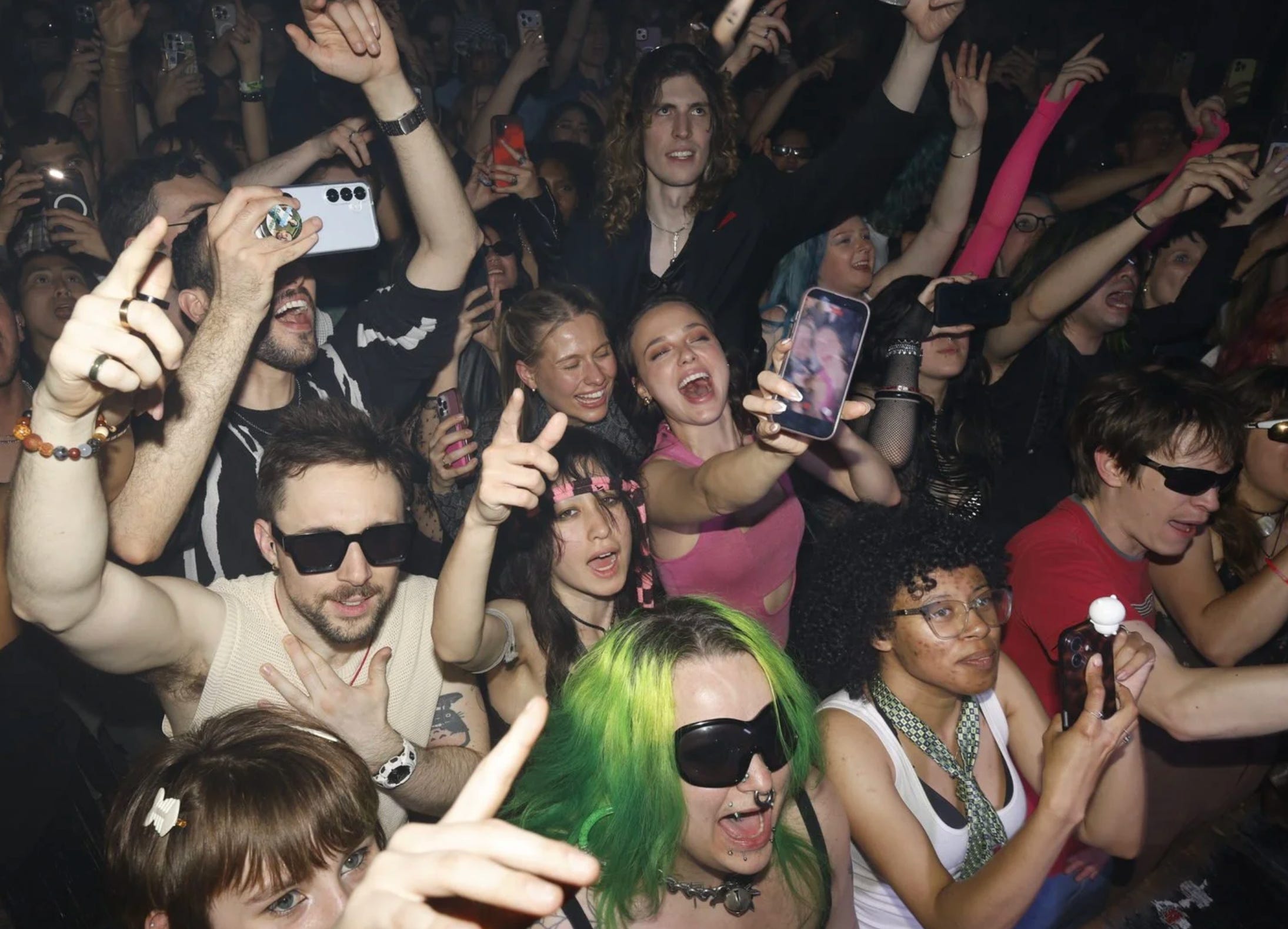
I first read the term “indie sleaze” in DAZED around Halloween, 2021. I remember the season because the trend piece felt a little like a jumpscare: The movement Pitchfork fostered had returned from the dead, necromanced by Gen Z’s raised on MP3s.
“The [original] Indie Sleaze movement… championed a hyperactive aesthetic, pulling from the ‘80s as much as they did 90s grunge, capturing all the hedonism with spontaneous and provocative flash photography,” said the piece. “It was a mish-mash buffet of chucking, smearing, and clashing, and its lodestone was American Apparel.” Now, it was returning as a TikTok aesthetic, spurred on by influencers clocking “an obscene amount of evidence” that the old vibes were resurfacing.
This revival of mid-‘00s party-rocking occurred right at the stir-crazy, wall-climbing, tail-end of lockdown, as people were spilling back into the streets and packing out clubs. It also coincided with a time of renewed cultural sensitivity following a series of long-overdue reckonings: post-social distancing, post-#MeToo. The world was pent up and set to explode, but also wiser, more cautious, on edge. The era of drug-and-sex-fueled DIY club hedonism was long gone, but as for the image and style? We were so back.
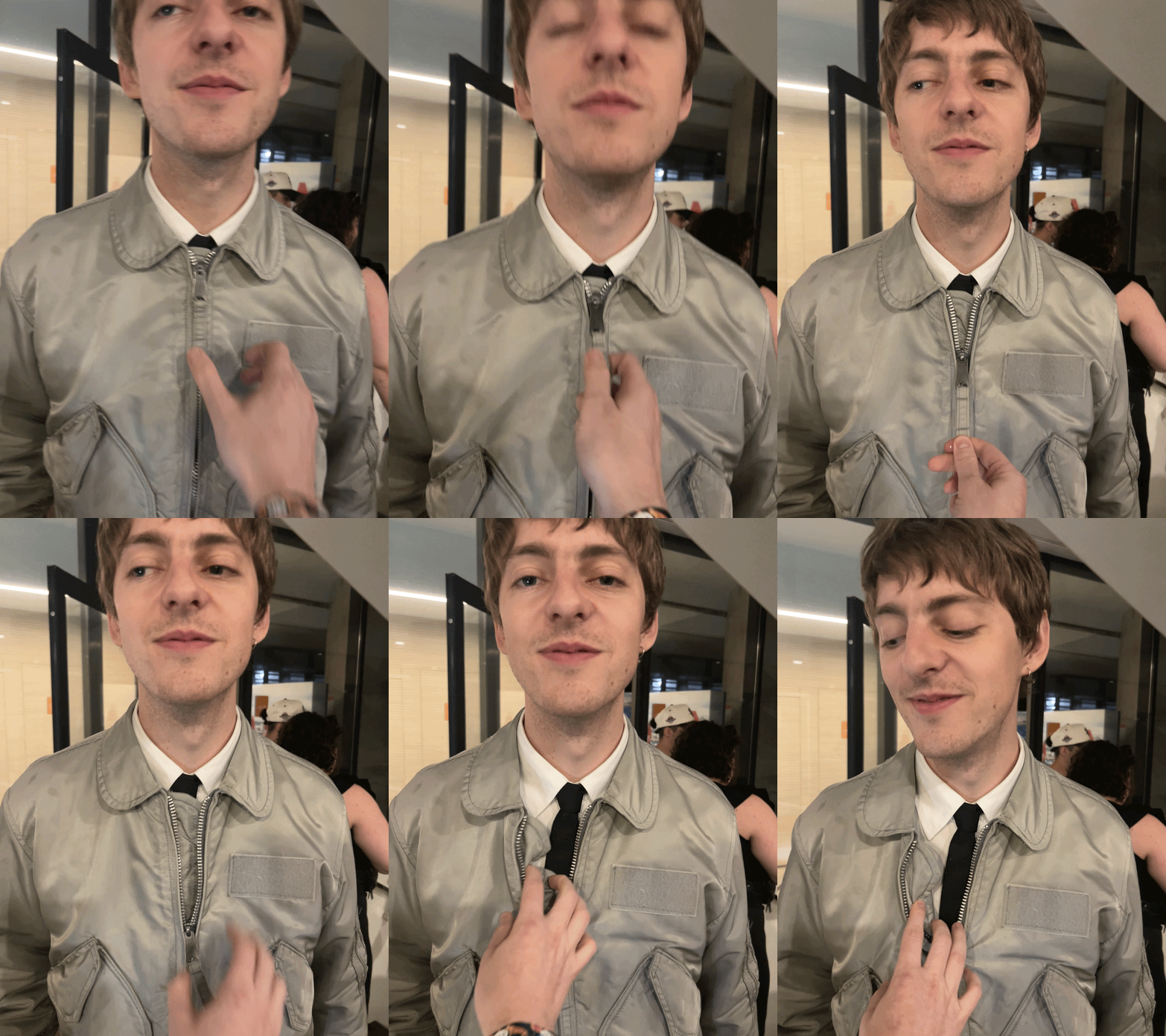
It didn’t take long for music to catch up. One of the first acts to earn the “indie sleaze” tag, the Dare, channeled the spirits of early ‘00s disco-punks like the Rapture, LCD Soundsystem, and Radio 4— bands who, themselves, had refashioned ‘80s post-punk as party music for the post-9/11 years. I remember seeing the Rapture at Chicago’s House of Blues then, and being so electrified by how seamlessly they mashed dance rhythms and vintage synths into spiky indie rock that it inspired me to write this certifiably unhinged review, helping catapult their DFA debut to the top of Pitchfork’s best albums of 2003. That record, Echoes, fused rock with electronics so successfully that it now sounds commonplace, but at the time, it was thrillingly new— one of a few critical flashpoints that ignited an era of dance-punk, bloghouse, and new rave.
As the sleaze revival came into sharper focus, acts like the Hellp and Snow Strippers incorporated the kind of filthy, late ‘00s electro that sets off dance floors: Justice, Peaches, Soulwax, SALEM, Crystal Castles. These were sounds that triggered flashbacks to both childhood innocence and the before-times internet, evoking a time prior to the near-extinction of that special joy we once called “fun.” For a while, this movement seemed like just another short-lived trend, one that might produce a handful of era-defining singles before blinking out forever.
Instead, it’s proved far more durable than I could have imagined.
The genre’s early, post-COVID hype now feels like eons ago, and increasingly, so does the peak saturation of Bratmania. Yet, last month, trash-pop provocateur Slayyyter— the self-described Wor$t Girl in America— parlayed her “Beat Up Chanels” into one of the wildest pop albums of the year. (She’s featured on my latest What’s Good playlist alongside fellow revivalist Tiffany Day, who punches up the retro-sleaze vibe with Y2k pop radio hooks).
The themes remain the same, but enough has changed in the world that Slayyyter’s lyrics feel like pure fantasy. Between Gen Z’s apparent aversion to sex and alcohol, the fentanyl crisis, a floundering job market, and a whopping 28% inflation rate over the last six years, “Beat Up Chanels”’s big chorus resonates because it feels like an inventory of everything the modern world has pushed out of reach:
“Money, drugs, chains on my chest, that vintage Celine / Diamond grills, champagne bottles, swagger I bleed / I want sex, money, bitches, and the stickiest weed / I want a cigarette.”
Girl, same.
Oh, to party carelessly in the modern world, under constant threat of surveillance. To pony up the cash for a single night of bottle service with your girls. To step out of the club for just one moment and bum an analog burner off that cutie blowing candy-vape clouds on the dance floor. Dream, baby, dream.
Maybe it’s for the best that the past stays past: the original era was fucking destructive. I lived in Chicago for much of the ‘00s, only moving to New York in 2007, but on my first weekend as a Brooklyn resident, I hit Studio B in Williamsburg— then the unofficial stateside capital of new rave— to dance to Simian Mobile Disco and Crystal Castles. Lasers and smoke flew everywhere, lights glowed and flashed in technicolor, guys and girls grinded up on each other in neon shades, shirtless and sweating. I started to notice that hard drugs were always around, wherever I went, and before long, I was meeting people who were visibly fucked on them. By the time the VICE empire crumbled a decade later, enough damage had ripped through these scenes to spark an irreparable backlash.
If nothing else, it might be wise to update the terminology. “Indie sleaze” was coined to denote post-millennial style trends pioneered by low-life predators in high-level positions (Dov Charney, Terry Richardson, et. al.), and it both trivializes and glamorizes that sordid history of exploitation. It’s not an especially descriptive sonic classification, either; as with chillwave before it, it’s a goof that caught on. Like Memory Tapes’ Dayve Hawke told The Wall Street Journal in a 2010 chillwave primer: “I wish they’d come up with a better name if it’s going to be a real genre.”
I won’t pretend to have the rebrand handy, but we’re now five years into the “sleaze revival,” and its influence and popularity are still accelerating. It could sound like corrupted MP3s streaming off an Iomega Zip drive (Frost Children, MGNA Crrrta), or a Cybertruck launching through a glass skyscraper, but everywhere you look, the lineage is being scrambled: the grinding, analog grit of Fakemink and 2hollis; the detached cool of Otha and Fcukers; and increasingly, the dreamy indietronica of acts like Bassvictim and ear. More and more, the movement is coming to define indie music in the 2020s.
I’m amused by how much present-day Pitchfork hates this stuff. Admittedly, not all of it works for me—certainly not all of it is good— but I’m heartened that even the bands I can’t stand are reconfiguring those serrated, bitcrushed textures in service of pushing music toward its next horizon. There were times during the last decade when indie rock felt like it was becoming a heritage genre, something preserved in amber for a waning festival circuit. But sleaze has acted as a jumper cable, shocking the scene back to life by making it sound as ugly and synthetic as the world around it.
Frankly, it’s kind of a relief. I’d be miserable if indie music had ended up a museum piece; I’d rather it be a riot. The fact that it’s mostly made by (and for) much younger people than me only underscores the degree to which it’s thriving. I love that the old guard is still relevant, still cool, still around to see their DNA mutated by the new guard. And I like how, even in the flashiest, most maximalist sleaze-pop, the old punk spirit shines through. After all, the intersection where high and low culture meet has always hosted the best parties.
This is awesome. Also timely as I realize (to my absolute horror) that it's Night Ripper's 20th anniversary. It makes sense that this genre is seeing such a sustained resurgence, but it's clearly an escape or a kind of role play now -- there's such a cavernous gap between what that music represents and the post-COVID introverted reality. "Back in our day" (sigh) it was just satirized life. I'm still having fun listening to the new stuff, though. And unlike the retro purists, I'm happy to have a name for it now.
My cousins were on Tumblr. A longtime Discord friend was on Tumblr. I was taught about its music scene and my life hasn't been the same...wished I had musical knowledge from when I born so I could witness some rising stars.
On my cousin's birthday, I gave her a playlist containing songs from the "blog era" (it sort of overlaps with indie sleaze). Check it out. https://open.spotify.com/playlist/71Y3lfv5K5gNAOl1fUWD7i?si=bobsy7jNT8S281pKhF46pg